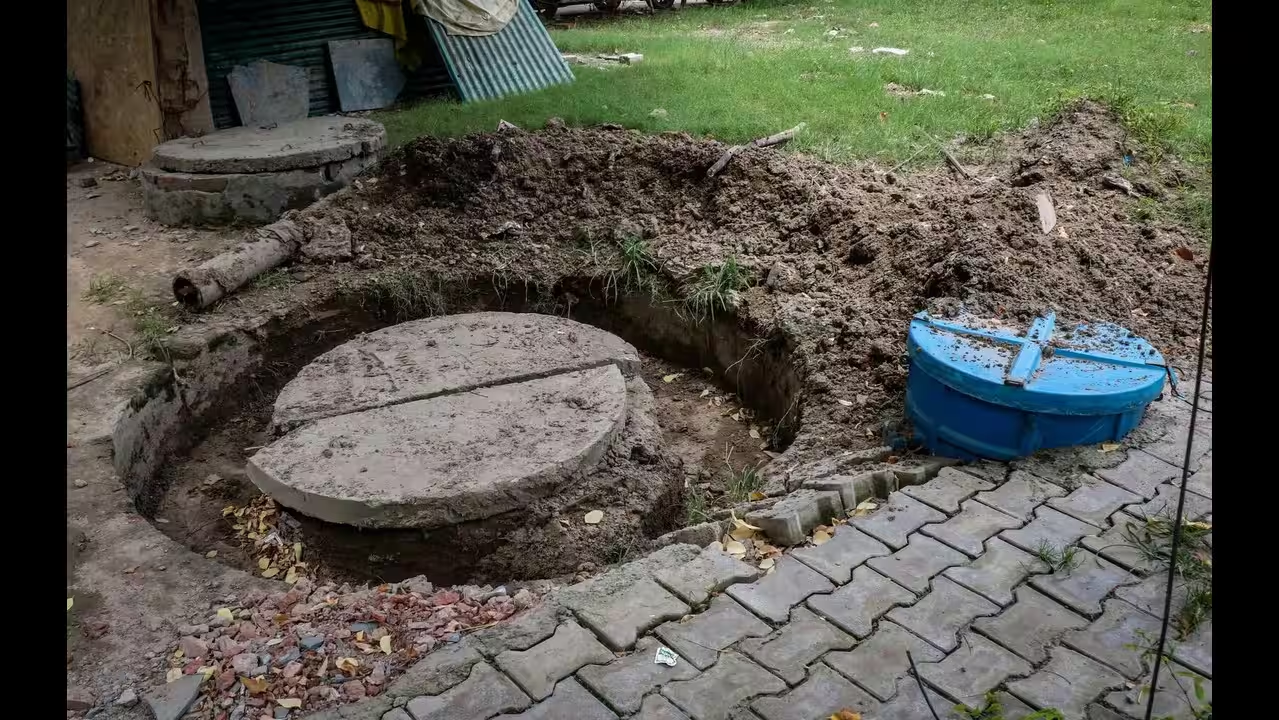
Every rainwater harvesting project looks the same on inauguration day: a new filter, a fresh recharge pit, and students holding a ribbon. Two monsoons later, though, the picture usually changes. Leaf litter chokes the mesh. The first-flush diverter sits unreset. The recharge pit silts up. In short, this second and unphotographed stage is where rainwater harvesting maintenance quietly decides whether a system lives or dies.
Pimpri Chinchwad offers the latest reminder. In early July 2026, the Environment Conservation Association (ECA) flagged that a CSR-funded RWH initiative across 52 PCMC schools had slipped into disrepair, and that many of the 52 systems had become defunct. According to the ECA, the schools took over upkeep after installation. However, a later assessment found that many systems had simply stopped working for want of basic care.
The ECA says it raised the alarm repeatedly. Over the past year, it approached PCMC’s education and environment departments, assistant commissioners, and other officials. Yet no corrective action followed. Meanwhile, the city keeps facing water cuts and rainfall deficits — the very conditions these systems were meant to soften.
It is worth being precise about the lesson. This is not a story about a careless NGO, negligent schools, or an indifferent civic body. On the contrary, everyone involved wanted the systems to work. The failure is structural, and that is exactly why it matters.
A national rainwater harvesting maintenance problem, not a Pune one
The PCMC episode feels familiar because it is. Across India, institutional and CSR-funded RWH tends to go quiet a few years after the installer leaves. In other words, poor rainwater harvesting maintenance is a national pattern, not a local lapse.
Consider Faridabad. Surveys of harvesting points across schools, parks, and government buildings found that roughly 75 to 80 percent had stopped working within a few years. Blockages, silt, damage, and faulty placement caused most of it. In Delhi, meanwhile, harvesting pits at government schools often clogged with plastic and debris, and some staff did not even know a system existed on campus.
Authorities then announce pre-monsoon drives to revive dozens of systems, which only proves how routinely they fall dormant. Different cities, different funders, yet the same failure curve. When a pattern repeats this reliably, the cause is not local negligence. Instead, it is the hardware and the maintenance model bolted onto it.
The real root cause: rainwater harvesting maintenance no one owns
Conventional rooftop RWH demands human attention at exactly the moments no institution reliably provides it. As a result, rainwater harvesting maintenance becomes the weak link.
Take the filter first. A standard screen or mesh traps leaves and silt on its surface. That protects the tank, but it also clogs the filter. Someone must then climb up, open the housing, and clean the mesh, often several times each monsoon. Miss a few cleanings, and the filter blinds over. Water sheets straight past, so either the recharge stops or dirty water enters the tank.
First-flush diverters create the same dependency. They dump the dirtiest initial runoff — dust, bird droppings, and roof grime — before clean water is collected. However, many designs must be drained and reset by hand between storms. If nobody resets them, they either divert nothing or push contamination into storage.
Now add the handover model that CSR and civic projects almost always use. The installer commissions the system, hands upkeep to a school with no plumber and no budget line, and then moves on. Consequently, maintenance becomes everybody’s job and therefore nobody’s. In effect, the hardware assumes a diligent caretaker will appear every few weeks for twenty years, and that assumption is the single point of failure.
More inspections will not fix this. An inspection tells you a system has already failed; it does not stop the failure. Therefore, the durable fix is to remove the human dependency from the hardware itself.
The design fix: rainwater harvesting maintenance that takes care of itself
This is where the engineering choice matters. WISY, the German technology RPV Wisy distributes across India, follows one simple principle: the filter should clean itself, and the system should not need a caretaker between rains.
Self-cleaning vortex filtration
Instead of trapping debris on a screen that clogs, the WISY vortex (WFF) filter uses the momentum of the flowing water. Clean water clings to a fine mesh and passes into storage, while leaves and silt keep moving and flush away to the overflow. In effect, the debris sheds itself. As a result, no one has to scrub a mesh after every storm, which is the very rainwater harvesting maintenance step that goes undone in the field.
Automatic first-flushing
The WISY design also handles the dirty first flow automatically. Because there is no diverter chamber to drain and reset, nobody has to remember it between storms. In short, the step that reliably gets skipped is simply designed out.
German engineering built to last
Durability matters too. These components serve for decades, not a single season. In an institution — a school, a housing society, or a campus — that longevity is not a luxury. Rather, it keeps a system alive through the years when nobody is actively tending it.
Passive water quality
Finally, WISY’s free-fall aeration enriches the collected water with oxygen as it enters storage. This keeps stored water fresh without pumps, chemicals, or manual dosing. Where the water is intended for higher-grade use, it can become potable-ready after a final disinfection step. Crucially, though, the baseline quality holds passively, by design, rather than by a maintenance crew.
Each feature maps onto a documented failure mode: the clogged mesh, the un-reset diverter, the corroded throwaway part, and the stagnant tank. Together, they turn rainwater harvesting maintenance from a chore into a property of the hardware.
What sponsors and civic bodies should specify
For anyone funding or approving institutional RWH — CSR teams, housing societies, facility managers, and municipal specifiers — the takeaway is clear. Move “maintenance-free by design” from an afterthought to a procurement criterion, and treat rainwater harvesting maintenance as an engineering question rather than a hope.
Before approving a system, ask a few simple questions. Does the filter clean itself, or must someone scrub a mesh? Is first-flush automatic, or does it need a manual reset? Are the components built to last decades, or replaced yearly? And what survives once the installer walks away? A system that answers well will likely still work two monsoons on. A system that answers badly will need a caretaker who, as PCMC and Faridabad both show, rarely appears.
Rainwater harvesting works. What fails is the assumption that someone will maintain it. So specify hardware that does not depend on that assumption, and let sound rainwater harvesting maintenance be built in from the start.
RPV Wisy helps builders, housing societies, institutions, and CSR teams specify low-maintenance, German-engineered rainwater harvesting filtration for Indian conditions. If you are planning an institutional RWH project — or reviving one that has gone defunct — talk to our team about designing it to stay functional long after handover.
Leave A Comment