In July 2026, ArchDaily ran a global reader debate under a provocative banner. Could we build with far less water? Should rainwater be treated as a design resource, rather than something to drain away? Writing for the platform, Fabian Dejtiar gathered a worldwide architectural community. The question was simple. What is the true water cost of construction itself? The debate’s consensus was telling. Before the industry can reduce its water use, it must first measure the true water footprint of every project. And its most useful reframe was this: rainwater is not waste. It is a material. For Indian builders, that reframe has a practical name: rainwater harvesting filtration.
That idea lands differently in India. Here, water stress is not a projection. It is the operating reality across most major metros. And in most states, rainwater harvesting (RWH) is already a legal requirement for new development. So while architects abroad debate the theory, Indian builders, developers and housing societies are positioned to act on it today. The technology that makes “rainwater as a material” real, rather than aspirational, is filtration. Rainwater harvesting filtration is where a WISY system earns its place in the specification.
The construction water footprint problem
Every project consumes water twice over. There is the blue water footprint. This is the fresh surface and groundwater used for mixing concrete, curing, dust suppression, batching and site work. And there is the grey water footprint. This is the clean water it would take to dilute the runoff and effluent back to acceptable quality. Add the embodied water in cement, steel and finishes. A building’s real water cost dwarfs what shows up on the site meter.
The built environment is one of the largest freshwater consumers on the planet. Credible estimates for construction and buildings cluster around a fifth of global freshwater use, though figures vary widely with scope and method. And the pressure is only rising. The OECD’s Environmental Outlook to 2050 projects that global water demand will grow by roughly 55%. That growth is driven largely by manufacturing, power generation and domestic use. For a sector that already competes hard for freshwater, tightening supply is the backdrop to every project now on the board.
The debate ArchDaily convened matters for a reason. It moves the conversation upstream, from “how do we treat the water we waste” to “how do we stop treating usable water as waste in the first place.”
From runoff to resource: rainwater as a material
Reframing rainwater as a material sounds abstract until you map it onto what a builder controls. A project team designs the roof, and that roof is a catchment surface. In most Indian cities, a single monsoon delivers plenty of rainfall. Across a large roof, that can supply a meaningful share of a building’s non-drinking water needs for months. The team specifies the downpipes, the filtration, the storage and the end-use plumbing. Every one of those decisions determines whether the rain becomes a reliable asset or simply overwhelms the storm drain.
Treated as a material, rainwater has a supply chain like any other. It has a source (the catchment), a processing step (filtration and debris separation) and storage (tanks that keep it usable). The end use covers flushing, cooling towers, landscaping and washing, and, after a final disinfection step, potable supply. The difference between a compliance box-tick and a genuine water asset is simple. It comes down to quality control at the processing step.
Why filtration is the make-or-break step
Raw rooftop runoff is not a usable material. It carries dust, leaf litter, bird droppings, atmospheric pollutants and the dirtiest first flow of every rain event. Stored untreated, it turns to sediment, odour and stagnation. That outcome has given cheap “collect it in a tank” RWH a poor reputation with facility teams. Water that must be manually skimmed, drained and scrubbed is a liability, not an asset.
Rainwater harvesting filtration is what converts collected rain into building-grade water. It is the single step that decides everything. Rooftop runoff either becomes a resource the building can plumb into, or a maintenance headache abandoned two years after handover. This is where the choice of system stops being incidental and becomes the whole decision. It is where WISY, engineered in Germany and distributed pan-India by RPV Wisy, is built to perform.
How WISY rainwater harvesting filtration works
WISY’s rainwater harvesting filtration follows a proven four-stage principle, refined over more than 30 years, engineered to deliver clean, high-quality water continuously without asking a maintenance crew to intervene.
The self-cleaning vortex fine filter
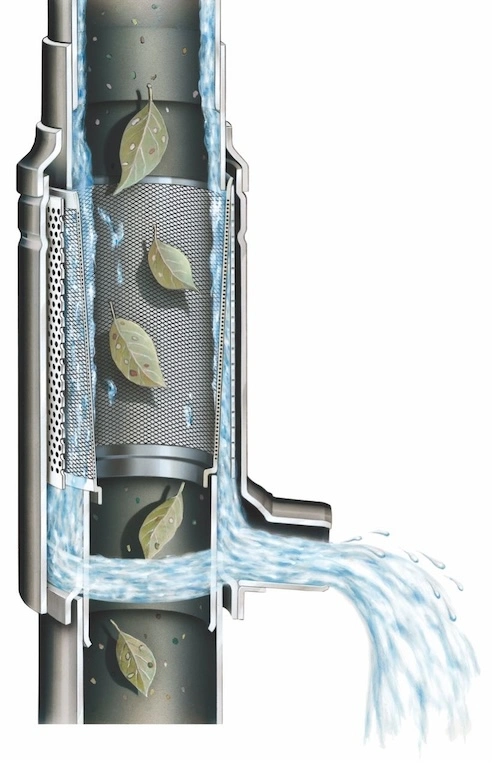
At the heart of the system is the WISY vortex fine filter, and its defining feature is geometry. The stainless-steel mesh is mounted vertically. As water falls through, it clings to the mesh and passes into storage. Meanwhile, leaves, moss and grit fall straight past and wash away with the residual flow. There is no horizontal basket to clog or scrub, so the filter keeps working right through a downpour instead of blinding over. Around 90% of the rain is captured, and the rest rinses the screen clean. The pipe never narrows, so nothing short of a tennis ball off the roof could block it. For a housing society or facility team, that vertical-mesh design pays off. The system runs for years on minimal attention, rather than a technician call-out after every storm. And low O&M is often what decides whether an RWH investment pays back.
Auto First-Flush
The dirtiest water of any rain event is the very first flow off the roof. It carries the dust and debris that has collected since the last rain. The automatic first-flush function handles that initial flush at the start of the event, keeping it out of the clean stream. Once the first flush has passed, the filter settles into normal operation. It happens automatically, with no valve to open and no diverter to reset between storms.
Oxygen enrichment keeps stored water fresh
Water quality is set at the filter and protected in the tank. As rainwater passes the vortex filter it is aerated and enriched with oxygen, which inhibits the anaerobic bacteria that cause odour and spoilage. In storage, three coordinated parts keep it that way. A calming inlet distributes incoming water gently, so it never stirs settled sediment. A floating suction filter draws supply from the cleanest layer, around 20 cm below the surface. And a multisiphon overflow skims the top layer, so oxygen exchange with the air stays optimal. Together they keep a large monsoon catch clear and usable through long dry spells.
German engineering, proven over 30 years
WISY systems are engineered and manufactured in Germany. They have been proven in rainwater systems worldwide for over three decades. For specifiers, that track record means a great deal. You get predictable performance, long service life and fewer surprises from a component buried in a plant room or below grade.
Together these deliver clean, high-quality water suitable for the great majority of a building’s non-potable needs, and potable-ready water after a final disinfection step. WISY filtration produces building-grade water; a downstream disinfection stage is what qualifies it for drinking use.
Explore the WISY vortex fine filter and rainwater filtration range.
What this means for builders, societies and institutions
The business case is straightforward once rainwater is treated as an asset rather than a regulatory obligation.

Lower dependence on tankers and municipal supply. A well-filtered rainwater system offsets a substantial share of a building’s non-potable demand. It directly reduces tanker purchases and municipal draw, costs that only rise as urban water grows scarcer.
Compliance, done properly. RWH is mandated for new development across most Indian states. A WISY rainwater harvesting filtration system meets those norms with infrastructure that actually works long after the completion certificate, rather than a token tank that fails an audit or falls into disuse.
ESG and green-building credentials. Measurable water reuse contributes to IGBC and GRIHA ratings, and to the ESG reporting institutional clients and investors increasingly expect. A quantifiable water asset is far more defensible than a nominal one.
Lower long-term maintenance. The self-cleaning vertical mesh and the calming-inlet-and-multisiphon storage design mean lower O&M and fewer service call-outs over the system’s life. That is the metric a facility manager or society treasurer cares about most.
Talk to us about rainwater harvesting system design and consultation for your project.
Build with the rain, not against it
The global architecture community has arrived at a conclusion Indian builders can act on this monsoon. Rainwater is a material, and treating it as one starts with getting the quality right. Rainwater harvesting filtration is the step that turns runoff into a genuine, reusable water asset, and system choice decides the outcome.
RPV Wisy is the pan-India distributor of German-engineered WISY rainwater filtration systems. We work with builders, developers, architects, housing societies and institutional clients to design systems that fit the project, the roof and the compliance requirement. Whether you are planning a development, retrofitting a campus, or making an existing RWH installation actually perform, talk to our team. Contact RPV Wisy to schedule a consultation and turn your next project’s rooftop into a working water asset.
Editorial hook draws on ArchDaily‘s July 2026 feature “Building Without Water: A Debate on the Water Footprint (and Rainwater as a New Material)” by Fabian Dejtiar: archdaily.com. Water-demand projection: OECD Environmental Outlook to 2050.
Leave A Comment