
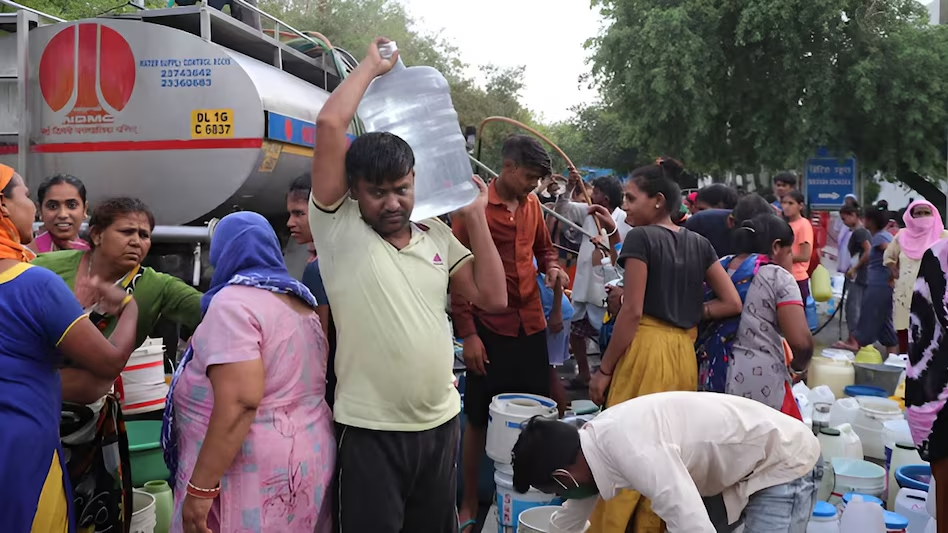
Every summer, the same scenes repeat across Delhi: residents lining up for tanker water, neighbourhoods reporting shortages, groundwater tables dropping further, and state governments trading blame. The pattern raises an obvious question — Delhi has poured money into water infrastructure and secured supply deals with neighbouring states, so why does water insecurity keep coming back?
The honest answer is that this is less a scarcity problem and more a governance one.
Too dependent on imports
Delhi sources more than 90% of its roughly 1,000 million gallons per day (MGD) of water from neighbouring states. That dependence leaves the city exposed to interstate disputes, seasonal swings, infrastructure breakdowns, and rising competition for water across northern India. Even with this imported supply, the city runs a demand-supply gap of about 250 MGD. As the population keeps growing, leaning harder on external sources isn’t a sustainable long-term plan.
Rain that goes to waste
Scarcity isn’t really the core issue — underuse is. Delhi gets an average of 744.4 mm of rainfall a year, concentrated in the monsoon months. Experts estimate that a single 100 mm rainfall event, if harvested effectively, could conserve around 17,600 million gallons of water — roughly 14 days of the city’s current demand. Yet most of this water simply drains away instead of being captured or used to recharge aquifers. Delhi has had rainwater harvesting provisions in its Development Plans since 2001, but implementation and monitoring remain weak.
Borewells as a parallel water system
Groundwater extraction has made large parts of the city more vulnerable, with borewells effectively functioning as a second water network for households, businesses, and institutions. The Central Ground Water Board reports Delhi’s extraction rate improved to 92.1% in 2025, down from 100.77% in 2024 — an improvement, but still not enough buffer against drought years or climate shocks. Of the city’s 34 tehsils, 10 are classified “over-exploited,” 11 “critical,” six “semi-critical,” and only seven “safe.”
Disappearing wetlands and floodplains
Delhi’s natural water assets are deteriorating fast. A University of Delhi study found South Delhi lost about 97% of its wetlands between 1991 and 2021, while built-up land grew by more than 70% in the same period. Over 75% of the 9,700-hectare Yamuna floodplain has been encroached upon. A city that floods and runs dry in the same year has a serious planning problem.
Leaky pipes, wasted treatment capacity
Ageing pipelines, leakages, theft, and unauthorised connections continue to erode distribution efficiency — cutting non-revenue water losses is essentially “new” water without building a single reservoir.
The bigger missed opportunity is sewage treatment. Delhi has a treatment capacity of about 794 MGD but treats only 584 MGD, leaving more than a quarter of installed capacity unused. Even the treated water is barely reused. Recycled water can serve landscaping, construction, industrial cooling, and other non-potable needs — every litre reused frees up an equal amount of freshwater for drinking and domestic use. Delhi still treats wastewater as something to dispose of, not a resource to use.
The fix isn’t another mega-project
Climate change is sharpening all of this, producing the paradox of a city facing floods and shortages at once. The answer isn’t another large engineering project — it’s a shift in how water is governed locally: functional rainwater harvesting, groundwater recharge, restored wetlands and floodplains, reduced non-revenue water losses, expanded wastewater reuse, and water governance systems that talk to each other instead of operating in silos.
Delhi’s water crisis is a preview of what other fast-growing Indian cities will face. Water security, going forward, will depend less on how much water a city can import and more on how well it conserves, recycles, and governs what it already has. Until that shift happens, every summer will bring back the same tankers, the same queues, and the same crisis.
Source: Adapted from reporting by Dhaval Desai, Observer Research Foundation, originally published in Hindustan Times.
Leave A Comment