
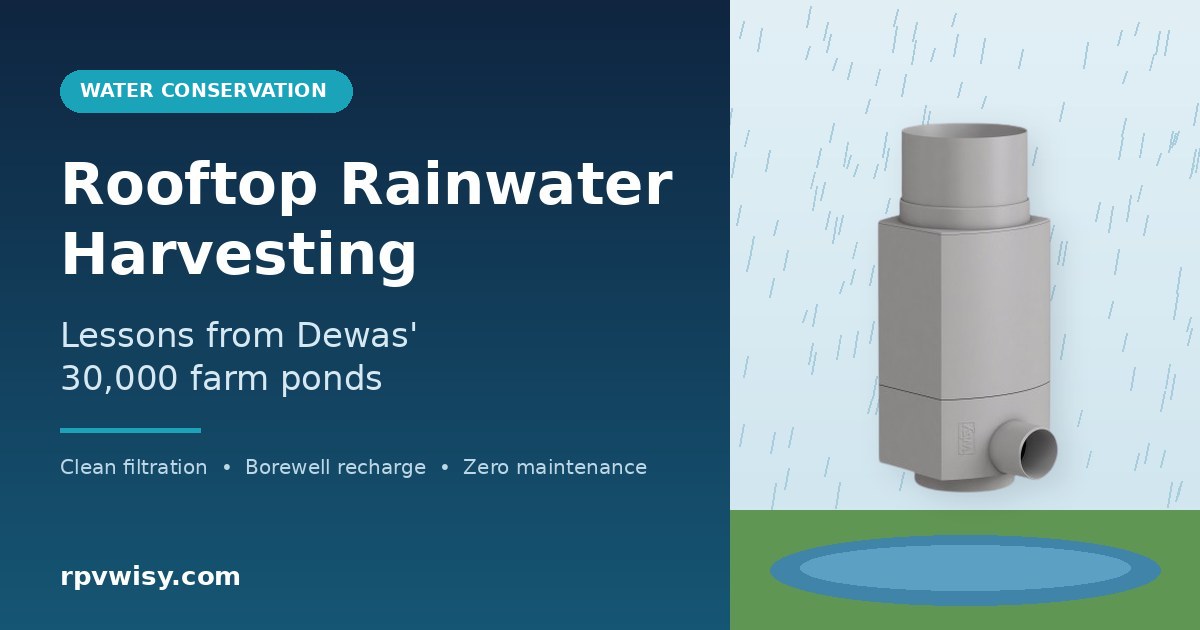
Can rooftop rainwater harvesting do for our cities what farm ponds did for rural Madhya Pradesh? Twenty years ago, Dewas district faced a groundwater crisis. Tube wells kept multiplying, and as a result water tables kept falling. Today, however, farmers there run an estimated 30,000–35,000 farm ponds. Now they grow wheat, chia, fish and dairy where they once struggled for a single crop. One simple decision drove the change: stop letting the rain run away.
A recent Down To Earth report revisits the Dewas story. First, it shows what happens when people catch rain where it falls. At the same time, it honestly explains what storage alone cannot fix. Both lessons matter for every home, apartment, school and factory that is planning rooftop rainwater harvesting.
The Dewas story in numbers
Through the 1990s, Dewas did what much of India did. It drilled. For instance, the district had 3,887 tube wells in 1990. By 1998, that number had grown to 14,172. Then, by 2009–10, it crossed 23,000 tube wells and 36,000 wells. Every new borewell pulled water out of the ground. Meanwhile, almost nothing put water back.
In 2006, collector Umakant Umrao started a different conversation with farmers. First, he convinced about 40 large landholders to give up a slice of land for ponds. In this way, the ponds would hold monsoon runoff on the farm. Within 14 months, farmers had dug around 2,000 ponds. After that, the idea spread from farmer to farmer. Today, the villages of Dhaturiya and Gorwa alone have more than 200 ponds.
What changed on the ground
- New income: One Nipania farmer harvests about 50 tonnes of fish every alternate year. That catch is worth roughly ₹1 crore. Similarly, a farmer in Khoob earned ₹23 lakh from chia seeds. A Dhaturiya farmer sold ₹60 lakh worth of wheat in 2025.
- Assured irrigation: Because farmers now store water through the dry months, they grow wheat, oilseeds and chia. Many also run dairy and fish farms.
- Local recharge: Hydrogeologist Sunil Chaturvedi says some pond water seeps into the ground. As a result, it may add to recharge. In January 2025, parts of the district had groundwater just 2–5 metres below the surface.
The part of the Dewas story that’s easy to miss
Here is the uncomfortable fact. Even after tens of thousands of ponds, the Central Ground Water Board still rates Dewas as overexploited (2023 assessment). District-wide, farmers pump out nearly 80% of annual recharge. In Dewas block, however, they pump 110.88%. In other words, people take out more water than nature puts back.
Experts in the report also raise fair questions. For example, Shashi Poonam Indwar of the National Institute of Hydrology asks two things. Have well levels really risen over the long term? And have small farmers shared the benefits? The report adds a practical point too. A farmer with 2 acres cannot give up a third of his land to a pond. That would risk his family’s food security.
Rooftop rainwater harvesting: three lessons from Dewas
1. Rooftop rainwater harvesting needs no extra land
In Dewas, land was the biggest barrier. After all, a pond eats into farmland. A roof, on the other hand, has no such trade-off. Homes, apartments, schools and factories already have a ready-made catchment. Yet most of them waste it every monsoon. For example, a 1,000 sq ft roof in an area with 800 mm of yearly rain receives about 74,000 litres of water. A good system can capture most of it. In short, rooftop rainwater harvesting applies the Dewas principle without giving up a single square foot.
2. Rooftop rainwater harvesting must mean clean recharge
To begin with, open ponds collect silt, leaves and organic matter. When dirty water enters a recharge pit or borewell, fine sediment slowly clogs it. Over time, it also blocks the path to the aquifer. This is one of the main reasons many systems in India stop working within a few years. Therefore, if recharge is your goal, filtration is not optional. A good filter keeps your rooftop rainwater harvesting system working year after year.
3. Rooftop rainwater harvesting should need no maintenance
Dewas succeeded because farmers saw a direct, visible return. In cities, by contrast, systems usually fail because nobody cleans the filter. If a filter needs a monthly clean-out, people will simply forget it. For this reason, your filter should be self-cleaning and power-free.
How WISY filters improve rooftop rainwater harvesting
RPV WISY supplies German-engineered WISY rainwater filters across India. We designed our range around the exact problems Dewas exposes: clean water, reliable recharge and near-zero maintenance.
| Dewas challenge | What a WISY system does |
|---|---|
| Silt and debris entering storage or recharge | Self-cleaning vortex filtration. A fine stainless-steel mesh draws water in by adhesion. Leaves and debris slide past and flush away. |
| Dirty first runoff (dust, bird droppings, roof residue) | Automatic first flushing. The filter diverts the first dirty flow without valves, timers or manual work. |
| Stored water turning stale | Oxygen enrichment. Water picks up oxygen as it passes the filter, so stored water stays fresh. |
| Systems abandoned due to maintenance | Zero power, zero consumables. Robust German engineering keeps working season after season. |
| No land available for ponds | Compact downpipe and underground filters fit on existing rain pipes or below ground. You lose no usable space. |
You can then send the filtered water to a borewell or recharge pit. This puts water back into the aquifer, just as the Dewas ponds aimed to do. Alternatively, you can store it in a sump for flushing, gardening, washing and cleaning. Filtered rainwater is potable-ready after a final disinfection step. As a result, it becomes a valuable supplement to municipal or tanker supply.
From farm ponds to rooftop rainwater harvesting
Umakant Umrao told Dewas villagers to first ask what the village could do for itself. The same advice applies to every housing society, school, hospital, hotel and factory in India. After all, many urban blocks already pump out more groundwater than they recharge, just like Dewas block. Put simply, every roof that sends rain into a drain adds to the problem. In contrast, every roof that filters rain and returns it to the ground helps solve it.
To sum up, Dewas proved that holding rain locally can transform lives. It also showed that quantity without quality is only half the job. With filtered rooftop rainwater harvesting, you can achieve both. Best of all, you need no extra land and almost no maintenance.
Make your rooftop work like a Dewas farm pond
Talk to RPV WISY for a site-specific rooftop rainwater harvesting and recharge design for your home, apartment, school or factory — anywhere in India.
Request a Free Consultation on WhatsApp Explore WISY FiltersFAQs on rooftop rainwater harvesting
What did Dewas do to fight its water crisis?
From 2006, farmers in Dewas district began building farm ponds on their own land. These ponds hold monsoon runoff. Today, the district has an estimated 30,000–35,000 ponds. As a result, farmers now irrigate year-round and earn from fish, dairy and high-value crops.
Did the ponds solve Dewas’ groundwater problem?
Not fully. The Central Ground Water Board still rates the district as overexploited (2023). In Dewas block, extraction stands at 110.88% of recharge. So, harvesting helped, but pumping still outpaces recharge.
Why should I filter rainwater before recharge?
Firstly, unfiltered runoff carries silt and organic debris. Over time, this debris clogs recharge pits, borewells and aquifer pathways. Filtering first keeps your recharge system working for years.
Can I start rooftop rainwater harvesting without free land?
Yes. Rooftop rainwater harvesting uses your roof as the catchment. Compact filters fit on downpipes or underground, so you lose no usable land.
Is filtered rainwater safe to drink?
WISY-filtered rainwater is potable-ready after a final disinfection step. Without that step, you can use it for flushing, gardening, washing, cleaning and groundwater recharge.
Source: Facts and figures on Dewas come from Amarendra Kishore, “How ponds brought prosperity in Madhya Pradesh’s Dewas“, Down To Earth, 1 October 2026. Farmers and the district administration led the Dewas initiative. We reference it here as an independent case study; it is not an RPV WISY project.
Leave A Comment